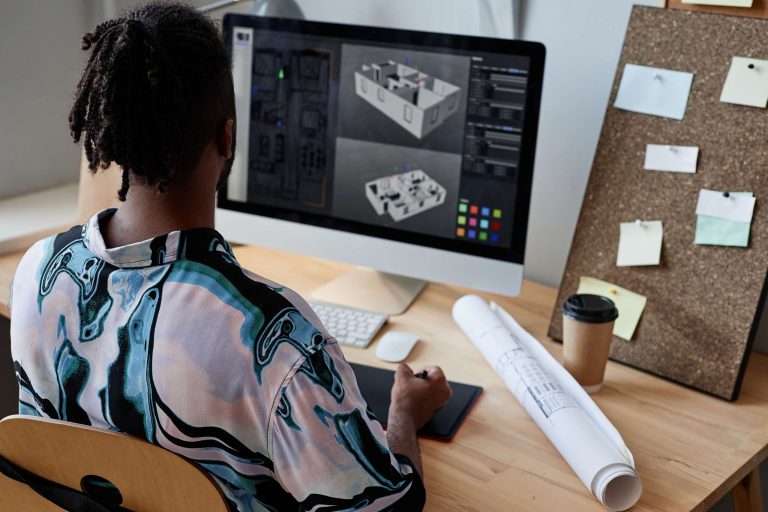
A good architect can see before they draw. Enter a room but don’t traverse it, look where the light collects, notice how the ceiling height makes you feel, imagine the ways you can walk through it. Practice this as a way to build your visual knowledge. Spend two minutes in a space without looking at the edges of the space, see if you can tell where they are by what is in your periphery. It’s more important to learn about space at the outset than about color.
If you feel that your powers of observation have been enhanced, try to express your observations in the form of a simple diagram which indicates the relationship of various components rather than attempting to show their size or shape. Show the relationship of the door to the window, the way that space is subdivided by groups of furniture which in turn generate circulation patterns, or how certain spaces might be expanded while others are diminished. Many people, trying to make an attractive drawing, expend most of their energy to this end. The result is a stiff hand, and a broken train of thought. If the drawing becomes stiff, use a different medium or larger scale. Accuracy is of secondary importance here, and movement of the line will be a good indicator of how you see movement in the space.
The proportions get lost in the sketch, and this gets especially difficult when drawing a room from memory. The fix is to not worry about the proportions so much, but compare measurements: which room is longer, where does the center of the room fall, how many steps does it take to get from one wall to the other? You can use the width of a doorway as a measurement to get the rest of the room to scale. If you think you got it wrong, do not erase. Draw it again, over the top of what you have done. Going over lines like this trains your eye to notice changes. Erasing and starting over prevents that from happening.
A 15-minute practice per day will yield improvements that don’t clog your busy days. Simply commit to 5 minutes of studying a space, 5 minutes of drawing its proportions, and 5 minutes of checking your drawing against the space. In the last step, use a pencil to circle proportions you think are off instead of fixing them immediately. The review is where you’ll start seeing patterns, which will, in turn, reduce those circles in the future as your brain adjusts to estimating proportions.
Sometimes you will get bored with this exercise, particularly if rooms look similar. That’s okay. That’s just perception learning. Going to a new location, looking at the space from a new vantage point, or drawing the same room at a different time of day all provide a new problem to solve even though the content is the same. At some point you will start to see the space as a three-dimensional space defined by light and circulation and walls rather than a series of objects within it. Then you can start to do some architecture. It’s much later that you need to worry about drawings and floor plans.