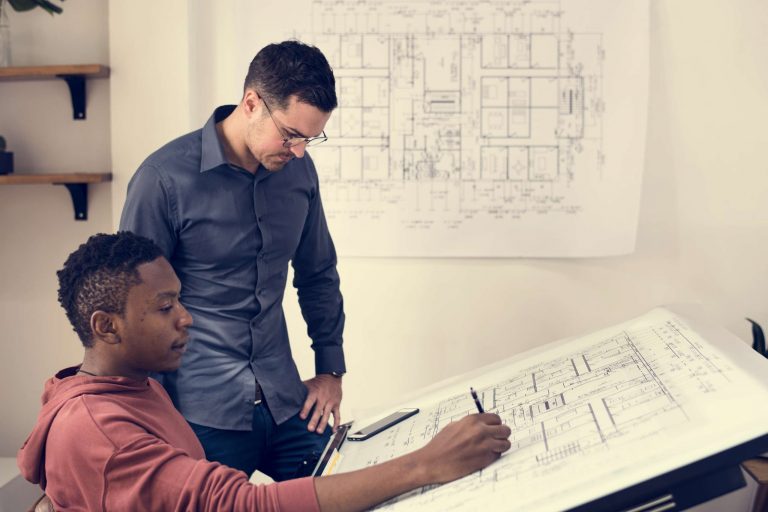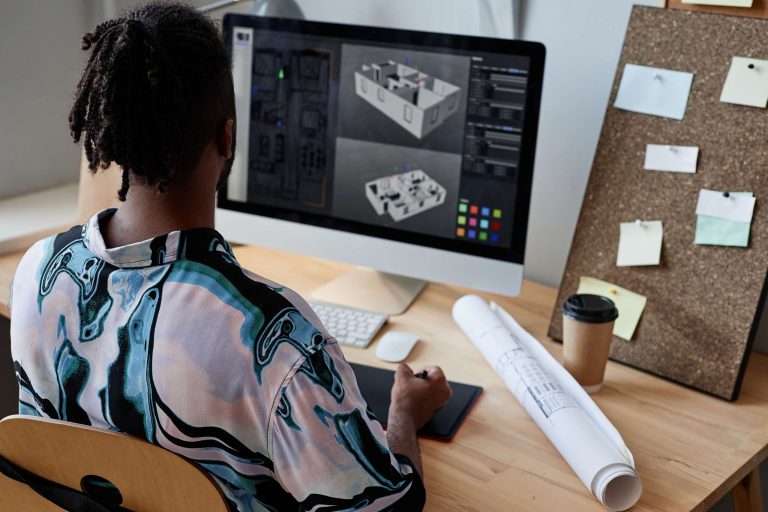
A sketch is one thing. A blueprint is another. At some point, your loose, doable ideas will need to be worked into actual plans that can be built on and implemented. Here are some ways to make this happen.
A drawing can express a lot of character, but it does not have structure. A lot of the time when a student learns to draw they don’t think about structure so they will draw nice organic shapes that would not be feasible to hold itself up, bridge itself, or connect. If you draw a sketch, one of the first steps to make that sketch into a structure is to decide where the mass is and where the void is. When you see your outline, where are the forces going to hit the earth? If you can’t tell, you need to simplify your design before you get into all the specifics.
Now do a pass of this drawing with another support-only layer. Overdraft the rounded parts and fillings with solid columns, walls, and cores that could support the mass above. You’re not taking all the magic out of this drawing. You are simply giving it structure. Many of us believe that this can be done for us later, but then we end up with nasty overhangs and unsupported sections. Add a grid or a rhythm to this drawing and you will be surprised. Even a loose series of support-guy-thingies turns a blob in the sky into a credible form.
The second problem is a counter-intuitive one, and that’s that novices have the tendency to overcompensate and end up making the design a rectangular block just to make sure it’s stable. It’s fine for some elements to be dramatic and heavy, just so long as they’re balanced out with less dramatic or heavier elements. If a projection is far off the ground, make sure there’s more underneath it, or if there’s nothing underneath it, then make sure the base is heavy. Lightness versus mass is what will lend the illusion an air of reality. Test whether it looks stable by covering most of the drawing and looking at just a bit at a time. If it looks like that bit will fall over, you’ve found a weak spot.
You can nurture this skill by practicing for fifteen minutes each day. Take everyday objects like a bookcase, a bus shelter or a flight of stairs, and try to draw them quickly, concentrating on how they keep themselves up. Don’t worry about their external appearance, just show where the weight goes down. Then think of a slight improvement that makes one of these features bigger, such as putting a deeper roof on a bus shelter or making the top of a staircase higher, and redraw it to show how you would get the weight down. It’s a useful exercise in modifying shapes to keep them standing up, a central skill in designing buildings.
This process can seem slow, since this understanding of structure comes more from accumulation than from a “eureka” moment. Save your initial drawings, and then go back to them a week later. You’ll see noticeable improvements. The line work is bolder, supports are in the right locations, and the proportions are more equal. Eventually, you will be more likely to think, “how would this stand?” and more often give your free floating concepts physical presence — they don’t feel like abstract doodles anymore.